(read the original article on Natalie’s Substack)
Recently, Arielle Swedback posted a Substack AI Report. Two thousand Substack publishers were asked how they’re using and thinking about AI. About 45% of respondents said they were using AI.
Is this a problem? Well, research has shown that AI is harmful in numerous ways. In my writing circles, people are trying to stay away from generative AI and, more broadly, the “AI voice.” What is the AI voice, you may ask? It’s complicated.

Photo by Kaitlyn Baker on Unsplash
The good thing is, if you’re a human, you’ll likely write like a human! Right? Maybe. A few weeks ago, my socials were teeming with mentions of the em dash—apparently the mark is favored by generative AI, so its usage can be a red flag.
Then again, human writing can and does get flagged by AI detection software all the time. Even the Declaration of Independence (drafted in the 1700s) was flagged as AI. Although that might make sense, given that boring writing is more likely to get flagged as AI.
But let’s get into the crux of this article: what makes your writing “sound AI?” I have done a lot of research, and I can’t help being frustrated by how vague the answer to this question can be. “AI uses the same sentence structure over and over,” “AI uses common idioms,” “AI uses words like ‘In conclusion’ and ‘Furthermore.”
Okay, but you know who else does those things? Humans.
True, AI models have been trained on human writing, so their output will sound similar to human writing. So then how can we tell the two apart? (Other than by counting em-dashes and semi-colons, that is.) Hilariously, one Reddit poster suggested changing all lowercase L’s to capital i’s. While I love the creativity, I was looking for something a bit more…reasonable.
This article is one of the most helpful I’ve found on the topic. In it, author Hareesh points to perplexity, burstiness, and inclusion of personal anecdotes, among other factors. I single these out because they struck me as the most compelling solutions.
Perplexity “measures how well [a language] model can estimate the likelihood of a word occurring based on the previous context.” Essentially, if you’re using common turns of phrase, like “a clean slate” or “a dark and stormy night,” AI detectors are more likely to flag your work as AI because of how many times language models have found these words close to each other in their training data. Here’s an example of high vs. low perplexity:
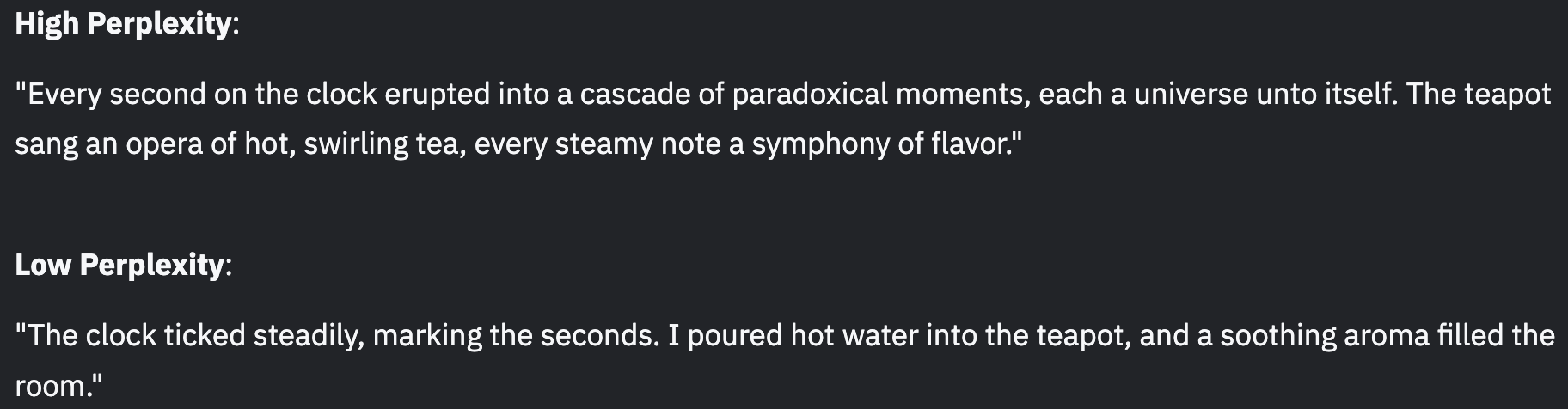
Clocks tick, teapots hold water—these are predictable word arrangements (though pouring water that is already hot into a teapot seems strange). So what’s the solution? Flex your creativity muscle and use less common combinations of words. Seconds erupting, teapots singing arias. This advice is quite serendipitous, since we writers are encouraged not to use common clichés but to invent our own unique similes and metaphors.
Burstiness is “the variation in the length and structure of sentences within a piece of content. It measures the degree of diversity and unpredictability in the arrangement of sentences.” Here’s an example of high vs. low burstiness:
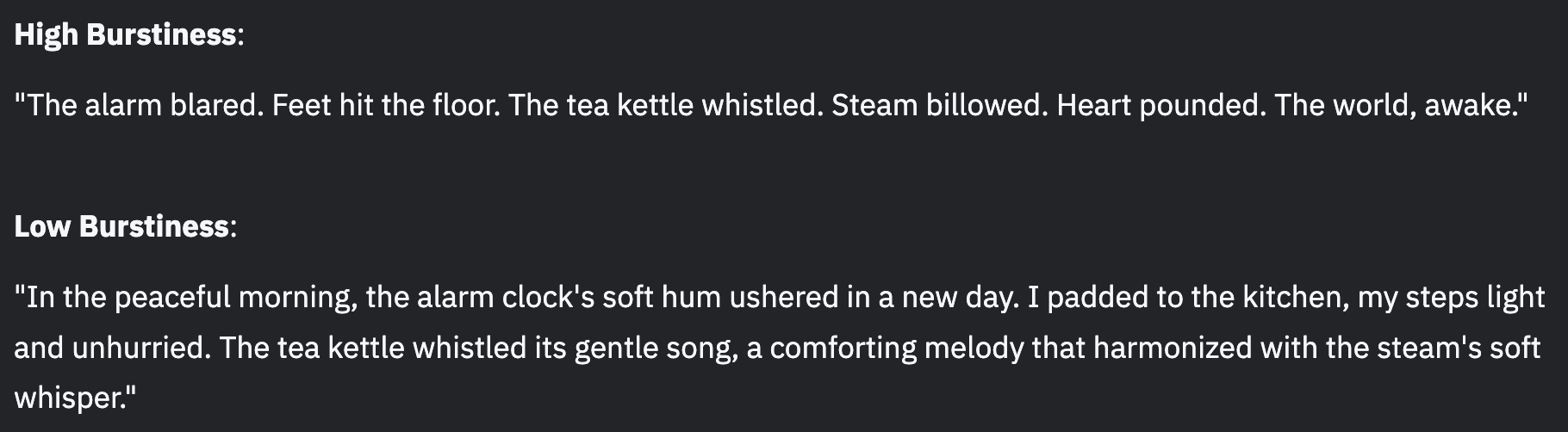
Though I think the high burstiness excerpt overdoes it just a tad, are we noting a pattern yet? AI is predictable. It writes formulaically. So, to ensure your content doesn’t sound like AI, write unpredictably. Include short sentences. Longer ones too. Vary your sentence structure and up the spontaneity of your writing.
Anecdotes: One tip I’ve seen repeated across various sources is to include personal insight, opinion, and anecdotes. All three are unique aspects of the human experience, and AI doesn’t have any of them (yet). How would that look? Maybe something like: The kettle whistled, its cry as shrill as the laughter of hyenas I heard one summer while on safari.
In all honesty, my initial thought on this matter was that it’s silly for writers to tailor our content to avoid sounding like AI. But upon reflection, doing so makes for more compelling material. Writing that is unpredictable, bursty, and loaded with personal stories and reflections is so much more captivating than grammatically perfect jargon (sorry, technical writers).
I will say, though, you’ll have to pry my em-dashes from my cold dead hands.
Natalie Shammas is a lawyer and PhD candidate at the University of Toronto, where she also teaches employment law. She completed a JD/MBA program at Osgoode Hall Law School and the Schulich School of Business in 2015 and was called to the Ontario Bar in 2016. Natalie is passionate about educating writers on legal issues that may impact them and has delivered numerous talks on the topic.